
Fine hair is not a reason to be turned away. It is a reason to be assessed properly.
Foster & Length Studio is a private hair extension studio in Lake Country, BC, working with women across the Okanagan whose hair has always been described as fine. It is the density that gets discussed most often here, more than length.
Fine is the word, but it is not really the problem
Fine describes the strand. What actually bothers you is what the strands add up to: a ponytail that has got thinner than it used to be, ends that taper away to almost nothing, and a part line that reads wider in some light than in others.
So you work around it. Hair gets backcombed in the morning to build something that will not last past lunch. It goes up in a bun most days, and that is not a style decision. There is a drawer with clip-ins in it that never blended, because the wefts were thick at the top and there was not enough of your own hair to hide the join.
And there is the specific version of this that fine-haired women get and nobody else does. You have been talked out of it. Somewhere along the line a stylist looked at your hair, said it would not hold extensions, and left it there. No assessment, no explanation, nothing to act on.
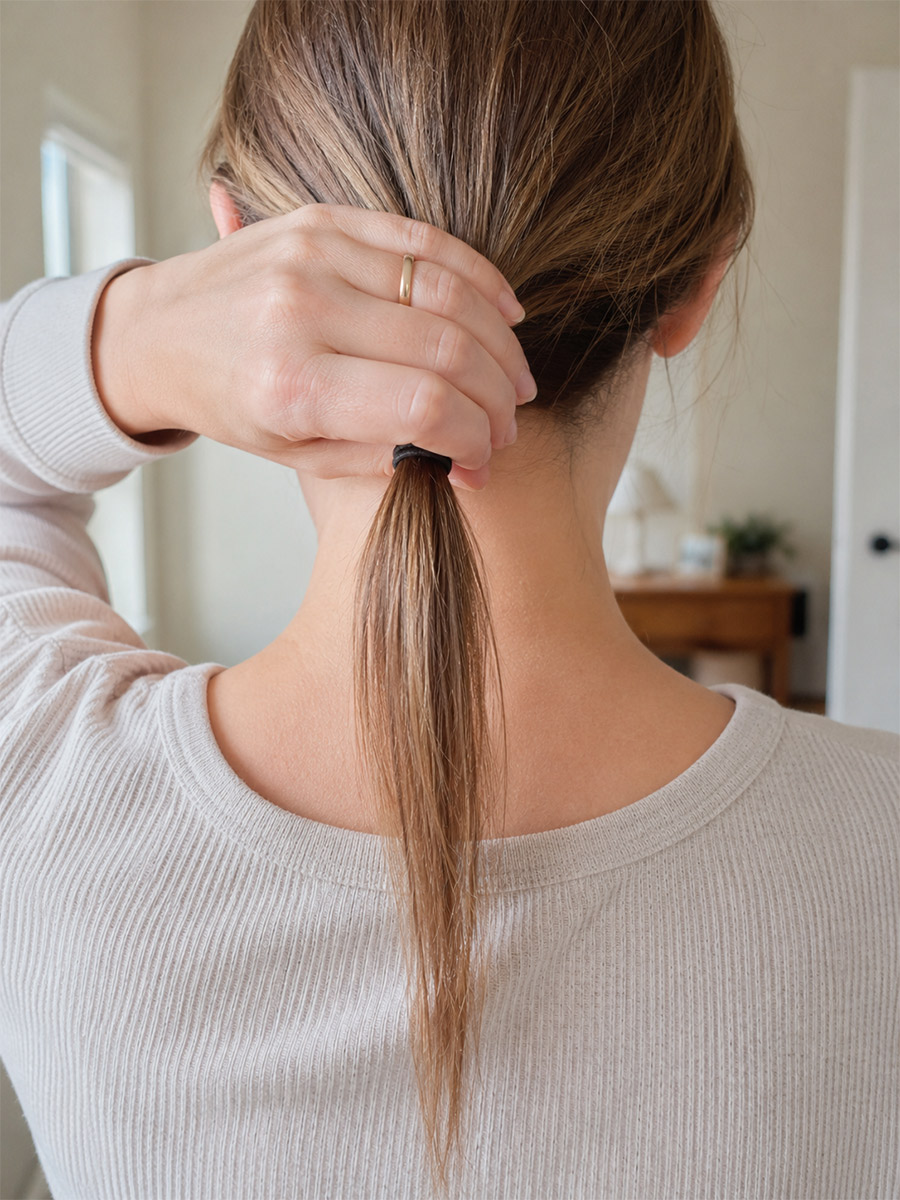
Being told no once tends to last a very long time
The daily arithmetic is on the main extensions page, and it is the same for everyone: the mornings, the products that did not work, the heat that is not doing fine strands any favours.
What is different here is that fine-haired women usually stop asking. One stylist said no, years ago, and the question was quietly filed away as settled. In the meantime the workaround got more elaborate rather than less, because it had to.
The cost of that is not really the time or the money. It is that a decision about your hair was made once, quickly, by someone who did not assess it, and it has been standing ever since.
Why you were told no, and why it was not really about your hair
The advice was probably not careless. It was probably just narrow.
Most studios fit one or two methods. A studio that only does one method has to answer every enquiry with that method, and a stylist who tells you your hair will not take it may be entirely right about the method she has. That is a true answer to a smaller question than the one you asked.
The reputation comes from older, heavier work. A lot of what people believe about extensions and fine hair comes from methods that hung a significant amount of weight from a small number of strands, or from watching that happen to a friend. That is a real memory and it is being applied to a different set of tools.
And "fine" gets used for two different things. Fine describes the thickness of an individual strand. Density describes how many of them there are. Someone can have fine strands and plenty of them, or thick strands with gaps between them, and the two situations are not solved the same way. Most conversations about extensions and fine hair never separate the two, which is why they go in circles.
None of that is something you could have worked out from a website, including this one. It is worked out by parting the hair in several places and looking.
What actually decides it is weight, and where the weight sits
The question is never whether your hair is fine. It is how much weight your hair can carry, and how that weight is spread across it. Those are two separate things and the second one is the one studios get wrong.
A row of weft is sewn along a line, so its weight is shared across every strand in that line. A method that attaches to a small cluster of strands concentrates the same weight onto far fewer of them. Same grams, entirely different load. That is the mechanical reason wefts come up so often for fine hair, and it has nothing to do with any brand name.
Two things follow from it, and both are physical rather than promotional.
The top edge of the weft decides whether there is anything to find. Fine hair has less coverage to lay over a row, so a weft with a thick top edge leaves a ridge. Hand-tied rows are sewn rather than machine-built and sit thinner against the scalp for that reason. Machine wefts sit flat and light. Which of the two suits you is a question about your own density, not a ranking.
Placement is mapped to your head, not to a pattern. Where rows can sit depends on where your density actually is, where there is tension already, and how you wear your hair. That is why the intake form asks whether you wear a high ponytail and whether you work out most days. Both change the map, and both are far easier to design around before the hair is on your head than afterwards.
What none of this can tell you is whether it is right for you today. That is the elasticity test, and it is the reason the audit comes before anything is ordered.
What clients with fine hair actually say afterwards
I never knew wearing full-time extensions could be this comfortable. This is a game changer from my clip-ins.
A Foster & Length client
That line comes up more than any other, and it is almost always about comfort rather than appearance. Women who have worn clip-ins have usually been putting up with a small amount of pain and a constant low-level awareness of where the clips are. The comparison they make afterwards is not with how their hair looked before, it is with how much of the day they used to spend thinking about it.
Client B — placeholder, not a real client
This block is a stand-in so the layout can be judged. It will be replaced with a real fine-hair client story before this site goes live, or removed. Nothing in it happened.
The real version needs three things and no more: what her hair was doing when she arrived, what was assessed at the audit and what that ruled in or out, and one specific thing she said afterwards. No percentages and no before-and-after figures.
One client's outcome is one client's outcome, and it is not a statement about what anyone else's hair will do. That is the whole reason the audit comes first, and it is why the honest answer at the end of an audit is occasionally to wait.
What happens if fine hair is what you are bringing
The process is the same as for anyone else. Three parts of it carry more weight when the hair is fine, so they are worth naming.
| At the audit | Why it matters more here |
|---|---|
| Density mapped in several places | Fine hair is rarely uniform. Where the density actually is decides where rows can go, and one reading at the crown is not enough |
| The elasticity test | A few strands are drawn gently to see how they behave under tension. This is the one that decides whether the hair can carry weight now, and it is the one most people have never had done |
| Coverage over the row | Whether there is enough hair to lie over a row without a ridge showing. This is the question a thick-haired client never has to ask |
You leave that appointment with a method recommendation, a firm price for the install and an honest estimate of what a year costs. Nothing is ordered before it.
If you have been told no before, get the reason
The hair-health audit is $50, takes about 45 minutes and comes off your install. You leave it knowing what your own hair can carry and why, which is more than most people are given.
Occasionally the answer is that now is not the right time. That answer is available at this appointment too, which is the point of doing it before anything is ordered.
- Compare all the methods, if you would rather keep reading
- See what it costs
Fine hair is a reason to be careful, not a reason to be dismissed
Leave your number and I will call you back to talk through what your hair would actually need.