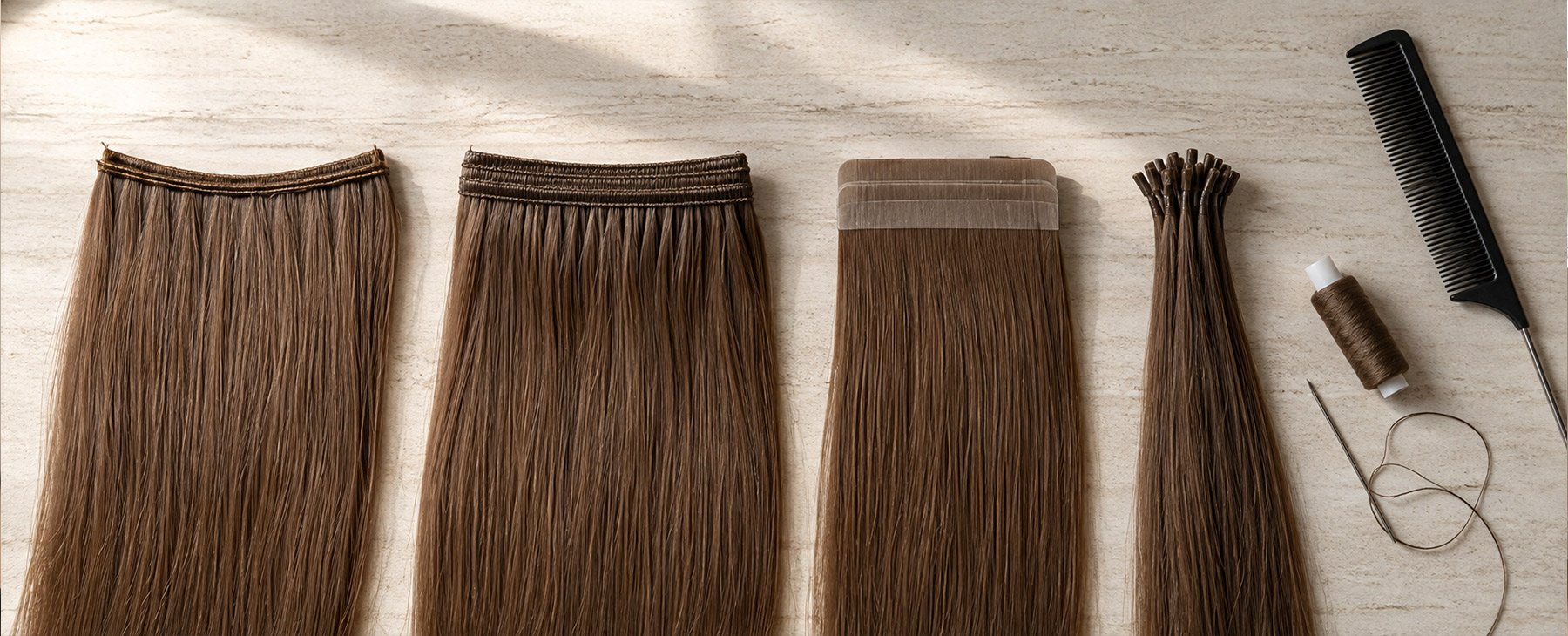
Which extension method is right for your hair?
Foster & Length Studio is a private hair extension studio in Lake Country, BC, working with women across the Okanagan who are stuck at exactly this point. Most have already read four or five method pages and come away more uncertain than they started.
Work through the list below honestly. Nothing is submitted anywhere and nothing is stored. It takes about two minutes.
Twelve things that decide it
Tick everything that is true. There is no good or bad score here. A high number does not mean bad news, it means the fit matters more and there are fewer methods that suit you.
What your answers actually mean
Nought to three
Your hair is in a straightforward position and most methods are genuinely open to you. The choice comes down to how you wear it and how often you want to be in the chair rather than to what your hair can take. Start at the methods and read the two weft options first, since those are the two most people in your position end up choosing between.
Four to seven
This is where most people land, and it is the range where a few methods quietly rule themselves out. Something in how you wear your hair, or what it has been through, narrows the field. It does not narrow it to one, and anyone who tells you it does over the phone has not seen your hair. The audit is what closes the gap between four options and one.
Eight or more
The fit matters a great deal here, and this is the group where the wrong method causes the most trouble. High ponytails, daily workouts, fine strands and previous chemical work all change where rows can sit and how much weight the hair can carry, and they compound. It is also the group most likely to have had a bad experience somewhere else, which was usually a placement problem rather than a hair problem.
Go to the audit before you go to a method page. It is the shortest route to a real answer, and occasionally it ends with a recommendation to wait, which is the answer worth the most.
Why this is so hard to work out on your own
It is not that you have failed to research it properly. The information genuinely is not there to be found, and there are three reasons for that.
Every method page is written by someone who sells that method. Read six of them and all six say theirs is the lightest, the most comfortable and the kindest to your own hair. They cannot all be right, and none of them are lying exactly. Each one is describing the case where their method is the correct choice, and leaving out the cases where it is not.
The method names are marketing, not categories. Several of the names you have read are trademarked systems belonging to particular companies, with their own training programmes. Two studios can be doing near-identical work under different brand names, and one studio can offer a name you recognise while doing it quite differently. Comparing names gets you nowhere.
The thing that actually decides it is invisible in photographs. How much weight your hair can carry depends on the density and the strength of your own strands, and neither shows up in a picture. It is measured by hand, by parting the hair in several places and by pulling a few strands gently to see how they behave. That is a five-minute job in person and an impossible one from a screen.
So the checklist above is not a shortcut around the audit. It is there so you arrive at the audit already knowing which of your own answers are the ones that matter, which makes that appointment shorter and considerably more useful.
What gets settled in person that a checklist cannot
| What is assessed | What it decides |
|---|---|
| Density and texture | The method, and how many grams of hair you actually need |
| Scalp condition | Where rows can sit, and whether a bead or a bond is a bad idea for you |
| Elasticity | Whether your hair is strong enough to carry the weight right now |
| How you wear it | Row placement, mapped to your head shape rather than a standard pattern |
| Colour, against a ring | The two or three tones that get blended, because one flat shade is what gives extensions away |
The elasticity test is the one most people have never had done, and it is the one that occasionally ends with a recommendation to wait. That answer is available at this appointment, which is the whole point of doing it before anything is ordered.
Where to go from here
If you ticked three or more, the useful next step is a hair-health audit rather than another method page. $50, about 45 minutes, applied to your install if you go ahead, and you leave it knowing which method suits your hair and what the whole thing will cost.
- Read how the methods actually differ, if you would rather keep reading first
- See what happens at the audit, start to finish, before you commit to it
- Check what it all costs
Requesting a callback costs nothing, involves no deposit, and does not book you into anything.
Bring your answers to the conversation
Leave your number and I will call you back. Tell me what you ticked and I will tell you, honestly, whether an audit is worth your time yet.